News
-
Penthera 2.2.0
-
Penthera 2.1.2
-
State of the Web 2026, follow-up: is the front-door gap real, and what do bot challenges hide?
A follow-up with new groups of sites and a new check, registered before it ran. Aggregates only.
-
Penthera 2.1.1
-
State of the Web 2026: how do websites score on front-door checks?
How do the most visited sites, and recent startups, score on the live check’s passive front-door checks? Aggregates only.
-
Penthera 2.1.0
-
E17: the registered run on macOS and Ubuntu made no outside connection and gave the same result, for every command in scope
E17: Does Penthera work unplugged, and give the same answer twice?
URL scans are covered only with --offline: without it, a URL scan downloads the Retire.js database. git runs outside the guard. Read the result
Re-run 29 Oct with the exact-path normaliser: verdict unchanged. Read the re-run
-
How we benchmarked Penthera against 25 free tools, losses included
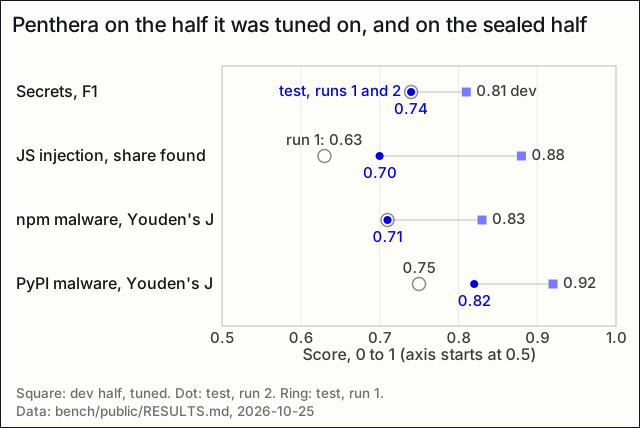
We tuned on one half of four public datasets and scored once on the other, sealed half. What that method is, what it found, and how far to trust it.
-
We benchmarked 10 free secret scanners on 2,220 labelled secrets. We came 2nd.
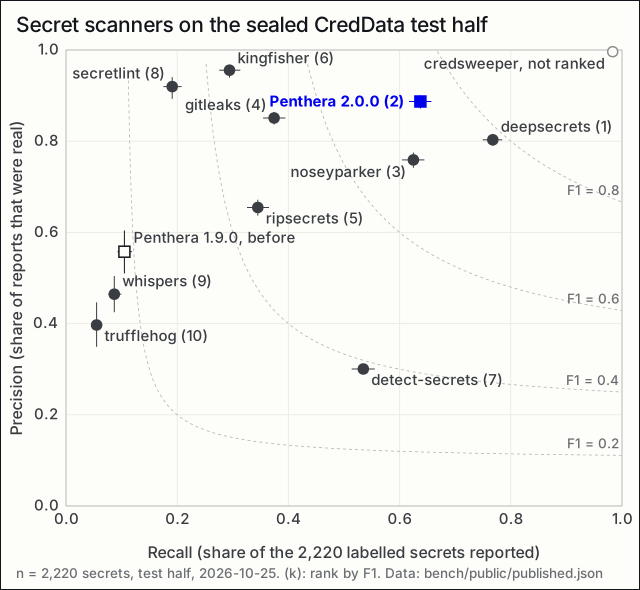
gitleaks, trufflehog, deepsecrets, Nosey Parker and five more on Samsung CredData’s sealed half, with intervals, the limits, and where Penthera loses.
-
E14: merging the free tools found more secrets but cost more than 0.02 precision, so --giants keeps Penthera-first
E14: Penthera plus the free tools, against each alone
Does one report from Penthera and the free tools find more than Penthera alone, without losing more than a fixed margin of precision? The answer sets the default for --giants. Read the result
-
Leaked secrets
Every tool, every interval, on the sealed half.
-
Malicious npm packages
Every tool, every interval, on the sealed half.
-
Malicious PyPI packages
Every tool, every interval, on the sealed half.
-
Injection bugs in JavaScript libraries
Every tool, every interval, on the sealed half.
-
Penthera 2.0.0
-
E11: Penthera 1.9.0 missed all five registered targets on the three public datasets
E11: Penthera on public benchmarks
One public benchmark per capability, with answer keys we had no hand in: secrets on Samsung CredData, code sinks on SecBench.js, malicious packages on DataDog’s dataset. Read the result
-
E11b: 2nd on secrets, tied 1st to 3rd on npm and PyPI malware, tied 1st to 4th on JS injection
E11b: improving Penthera on E11, without fooling ourselves
Tune on a dev half, then score a sealed test half once. Only the test half’s numbers are published as the after. Read the result
-
Penthera 1.9.0
-
eMudhra’s broken CA keys show in the public key, and the TLS check now looks for them
Each private key was an integer below 256, so a passive handshake is enough to find it. A match is proof, so the finding is confirmed.
-
GitLab’s critical patch: a passive scan cannot read a self-managed GitLab’s version
Asset fingerprinting is ruled out. The note proposes a rule that reads the version from the repository instead; no rule shipped.
-
PHP’s 21 Oct flaws: Penthera checks the version a site shows, and says when it cannot tell
Released in 1.8.0. A hidden version is never reported as safe, and the fixed versions match the ones in OpenAI’s own checker.
-
E1: Penthera’s accuracy on real code
How accurate is Penthera’s static analysis on real web apps and agent setups its authors did not write? Precision and recall per category, each with a 95% interval.
-
2026 agent incidents: six gaps for Penthera, from verifier integrity to agent sandboxes
Agents under evaluation reached real systems they were never meant to touch. Each lesson ends in an action, and the draft study E8 tests one of them.
Nothing matches this.